
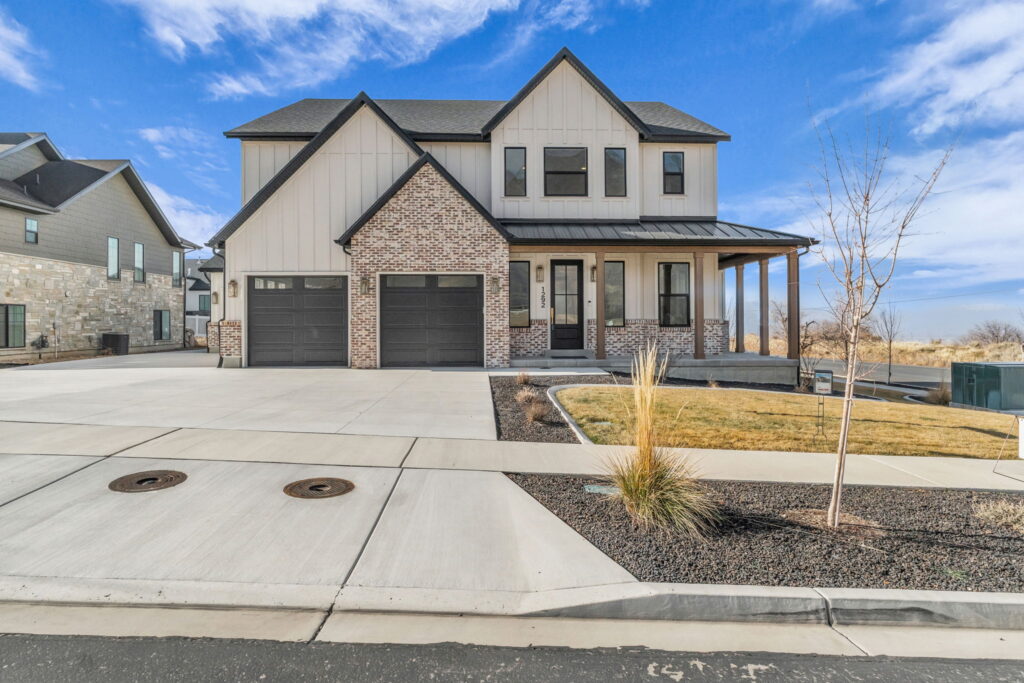
Cost is the question everyone has and almost nobody gets a straight answer on. If you’ve started researching custom home builders in Utah County, you’ve probably already encountered vague ranges, non-committal estimates, and a lot of “it depends.”
It does depend but that doesn’t mean you have to go into a build without a clear financial picture. Here’s what actually drives custom home building costs in Utah County, what realistic numbers look like, and how the right builder keeps your budget from spiraling.
What Drives the Cost of a Custom Home in Utah County?
Square footage and structural complexity This is the most obvious driver. A 4,500-square-foot custom home costs more than a 3,000-square-foot one — but square footage alone doesn’t tell the whole story. Vaulted ceilings, complex rooflines, below-grade spaces, and multi-level builds all add structural cost per square foot beyond the base rate.
Site conditions and lot preparation Utah County’s terrain varies significantly. A flat lot in a master-planned community has different site costs than a hillside parcel in the foothills above Mapleton or Spanish Fork. Grading, retaining walls, utility connections, and access can add meaningfully to the total project cost.
Finish level Custom hardwood flooring, natural stone countertops, custom cabinetry, smart home integration, high-end appliance packages, and resort-style outdoor living spaces all have real price tags. The gap between “builder grade” and “luxury finish” on a 4,000-square-foot home can easily represent hundreds of thousands of dollars.
Design and architecture fees Fully custom homes require architectural design. Some builders work with in-house designers; others coordinate with your preferred architect. Either way, design fees are a real line item in your budget.
Current materials and labor costs Building costs have shifted significantly in recent years. Utah County’s active construction market means labor is competitive, and material costs fluctuate. A reputable builder works with established trade partners to get reliable pricing — not inflated subcontractor markups.
What Are Realistic Cost Ranges for Custom Home Builders in Utah County?
Without knowing your specific lot, program, and finish level, precise numbers aren’t honest. What we can tell you is that luxury custom home construction in Utah County typically runs in the range of $350–$600+ per square foot for high-end builds, depending on all of the above factors.
For a 4,000-square-foot luxury custom home, that suggests a construction cost (not including land) in the range of $1.4M–$2.4M+. High-elevation builds, complex sites, or premium finish packages push toward the higher end.
These ranges aren’t meant to be alarming — they’re meant to set honest expectations. The homeowners who have the best building experiences are the ones who go in with clear financial parameters, not optimistic estimates from a builder who underbid to win the job.
How Nova Vista’s Firm-Flex™ Pricing Protects Your Budget
Budget uncertainty is the number one source of stress for custom home buyers. Nova Vista built the Firm-Flex™ pricing model to address this directly.
Here’s how it works:
- Firm costs are locked in at contract. This covers the structural scope of your build — foundation, framing, roofing, mechanical systems, and core construction elements. These don’t move.
- Flex costs are tied to your finish selections — flooring, cabinetry, countertops, fixtures, and other customizable elements. These are defined within a clear budget range, so you know your floor and ceiling before you make final selections.
The result: you always know where you stand financially. No mid-build surprises. No change order avalanche. Just a clear financial picture at every stage of construction.
This is meaningfully different from how most builders operate — and it’s one of the reasons Utah County homeowners choose Nova Vista when they’re serious about building.
What’s Not Included in Builder Pricing
Before comparing quotes from custom home builders in Utah County, make sure you’re comparing the same scope. Items that are sometimes excluded from base pricing include:
- Land/lot cost
- Architectural and engineering fees
- HOA fees and community infrastructure costs
- Landscaping and exterior hardscaping
- Furniture and interior design
- Pools, sport courts, and outbuildings
Ask every builder for a complete list of exclusions so you can make an accurate comparison.
Ready to Get a Real Number?
Nova Vista doesn’t do vague ranges or lowball estimates designed to get you in the door. We have a direct conversation about your vision, your site, and your budget — and we tell you honestly what’s realistic.
If you’re thinking seriously about building, the best first step is a free consultation. Schedule Your Free Consultation
Frequently Asked Questions
How much do custom home builders in Utah County charge?
Luxury custom home builders in Utah County typically charge $350–$600+ per square foot for high-end builds, depending on structural complexity, site conditions, and finish level. Total project costs for a 4,000-square-foot luxury home commonly range from $1.4M to $2.4M or more, not including land.
Why do custom home costs vary so much?
Custom home pricing varies because every project is different — different lots, different floor plans, different finish levels, and different site conditions all affect cost. The best way to get an accurate number is to work with a builder who evaluates your specific project rather than quoting generic ranges.
What is Firm-Flex™ pricing?
Firm-Flex™ is Nova Vista’s proprietary pricing model that locks in structural costs while defining a clear range for finish selections. It gives homeowners financial clarity at every phase of the build, eliminating the budget anxiety that typically comes with custom home construction.
How do I avoid cost overruns on a custom home build?
Choose a builder with a transparent pricing structure, get a detailed scope of work before signing, and understand exactly what is and isn’t included in your contract. Nova Vista’s Firm-Flex™ model is specifically designed to prevent cost overruns.